Covering University of Colorado sports, mostly basketball, since 2010

Showing posts with label Colorado. Show all posts

Tuesday, September 10, 2024

Glory, Glory Colorado

"... some so subtle you might not have even noticed... but your brain did." -- Mr Plinkett.

Memory is a funny thing.  We exist in a world of five senses, so our memories do, too.  A brief smell can unearth a childhood memory of a camping trip.  The taste of a favorite dessert can take you back to grandma's kitchen.  A flash of color can help recall that weird shirt you wore on your first date (you moron). A touch of your mother's hand can remind you of the value of family.  We value the practical because it grounds us in reality; it sets the terms of how we interact with the world.

Sound is just as important.  What we hear, even if unintentionally consumed, becomes entwined with our sense of place.  Any filmmaker worth their salt will talk about how the audio, the backing music, can almost do as much for a scene as perfect cinematography or the sharpest script.

And so, you may not have noticed "Glory, Glory Colorado" before, but your brain has.  

Seriously, close your eyes.  Think back to your first football game.  What do you hear?

Every time Ralphie runs, the Black and Gold faithful have heard the tune.  With every plunge into the endzone, Buff fans of all ilks and creeds, regardless of the current football coach, have celebrated to that tune.  Time's good, time's bad, the song is played.  It's been played at the Cotton Bowl, the Orange Bowl, the Fiesta Bowl, even the damn Blockbuster Bowl. It punctuated all 6 of Chris Brown's scores in 2001 against Nebraska.  It rang out when the Buffs claimed #1 in Miami.

As with all things, a song is only as important as the things it represents.  Lyrics, music, et al.  To me, "Glory, Glory Colorado" represents Boulder.  It represents Folsom Field.  It represents fall Saturdays in the greatest venue in all of sports.  And it represents something impermeable to the ravages of time -- the undying version of my 20-year-old self that still exists somewhere out there in the ether.

Your mileage may vary.  You may not have any active concept of that song, what it means, when it's played, or why it's important. Regardless of your opinion or preconceived notions, all of this has been called into question, recently.  First by the football coach, then the fanbase at large, then the national media.  It's all led many to ask questions. What is "Glory, Glory Colorado?"  Why is there such a kerfuffle over when and if it is played at football games?  Why should I care?

Well, you came to the right place.  I have some answers.

Today, I'll try to add some missing context to this discussion.  I'll talk about the University of Colorado's school songs (plural), when they're played, and the meaning and history behind each of them.  I'll talk about what exactly the marching band was told they could play, and what they were told they couldn't ahead of the season opener.  Then I'll talk about why I believe this discussion is important.

Some of this is researched history, thankfully researched by others. Walt Blankenship, in particular, has spent countless hours and his own money to research the hows and whys of the Golden Buffalo Marching Band, and the history of the school songs they play. I had the opportunity to speak with him last night on his findings (any errors in passing along his information are my own). Some of this is oral tradition, passed down by Walt and others.  Some of this is hearsay, especially the part about what went down before the NDSU game, which can easily be ignored.  And some of this is a personal experience, respectfully earned.  As such, my history professors would blanche at the fluctuating level of research and lack of sourcing herein.  So, take this as more of an opinion piece than any true tract of history.  

I'm also diving headlong into some minutiae here. If you want a TLDR, you've come to the wrong place.  Others, better equipped to be concise and pithy, may be more your speed.

In the end, I'm not trying to speak for Buff fans everywhere, for the band, or for anyone else.  I'm only, as ever, trying to speak for me, myself, and I.  

Enter at your own risk.

Monday, August 15, 2022

On the 2022 non-conference schedule

OK, so I went and did something today that I typically try to avoid -- I posed a speculative statistical opinion about Colorado Basketball without actually doing the research.

My tweet:

"[...] Tennessee aside (#9 in KP last year), this may be the softest non-con schedule Tad has put together while at CU. No judgment, it's hard to build a schedule, and a 20-game P12 slate leads you in this direction, but yo. Utah-esque."

Normally, I'd have actually looked at some records and some stats before positing something like that.  Today? No, not so much. That's my bad.

So, to make up for my error, I've cracked open the KenPom files and done some digging to try and actually understand this year's non-conference schedule, insofar as it compares to the rest of the Tad Boyle era.


The Context

CU released its 2022-23 non-conference basketball schedule at the start of the month; you can find it here. Just today, the Pac-12 released their conference weekly pairings, giving us fans a near-complete picture of the schedule. 

There are, to be completely straight, a dearth of "headline" programs in the non-conference portion.  This season, Colorado will be playing UC Riverside, @ Grambling, @ Tennessee (Neutral), Yale, CSU, North Alabama, Northern Colorado, and Southern Utah in their non-con.  This is in addition to three teams in their MTE, one of which will be UMass. 

To be fair, three of those teams (Tennessee, Yale, and CSU) made the NCAA Tournament last March, with two others (Northern Colorado and Southern Utah) making lesser non-conference postseason appearances (CBI and CIT, respectively).  Additionally, in the MTE, Colorado could see teams like Texas A&M and Boise St if the bracket falls the right way, who each were postseason entrants in March of 2022.

Still, at first blush, it's a soft schedule. Uninspiring, certainly.  A group of directional detritus that I would otherwise needle a conference opponent for drawing up.

But, is it really the softest that Tad and his staff have drawn up while at Colorado?

Wait, what is an MTE?

MTEs, or Multi-Team-Events, allow coaches to add in a non-conference tournament or similar to supplement their schedules. Often taking place in far-flung exotic locales (like Hawai'i, Puerto Rico, or the Bahamas), they're exceedingly common place, and rare is the major program's schedule that doesn't include one (Colorado's last season without an MTE was 2013-14).

Normally, NCAA rules limit a college schedule to 29 regular season games (plus exhibitions, either public or private).  However, by including a three-game MTE in your schedule, you can cram in a maximum of 31 games.  It comes at a cost, though: you're at the mercy of the MTE for your opponents, the bracket, etc.  

This year's example for Colorado is the Myrtle Beach Invitational (tickets on sale now!), which I will be attending in mid-November.


The Methodology

I thought the quickest and fairest way to quantify the difficulty of a given year's schedule was to average the *previous* year's final KenPom ranking of each team on the slate.  i.e., if I was looking at the 2013-14 season's schedule, I would compare it against the final KP rankings from 2012-13. 

Why did I do it that way?  Why not look at pre-season rankings or final rankings from the year in question? Why not something more complicated with weighting and such?

Well, first, KP doesn't keep his old pre-season rankings in a handy format that I can find. I imagine that's because his pre-season rankings are the result of as much statistical guesswork and calculus as hard data, but I digress.

As to eschewing final rankings from the actual year of the schedule? Well, I'll concede it's a flawed method, particularly in a sport where many programs can turn over dramatically year-to-year. However, I feel it's the most reliable way to understand the context behind the schedule heading into each season, rather than trying to justify against the results.  My purpose, after all, is to understand how this year's schedule can be viewed, not how it will. The *actual* difficulty of the current schedule is unknown, and won't be known until the end of December. I can't then compare that unknown against a known quantity, so I am trying and contextualize the 2022 numbers against something similar.

See, in any given season, there are breakout teams and disappointments that can have a dramatic effect on the final value of a schedule. Take last year's meeting with Milwaukee, for example. The Panthers, coming into the season, were viewed a dark horse candidate for an at-large berth in the NCAA Tournament. They were highly thought of, boasting some veteran components and an anticipated NBA lottery pick in Patrick Baldwin, Jr.  Baldwin, however, never showed that presumed promise under his father's (Head Coach Pat Baldwin) tutelage, struggling with injuries (only played 11 games for Milwaukee) and poor performances throughout the year. Without expected returns from their star, the Panthers, 120th in the preseason KenPom ratings, finished a dreadful 335th nationally.  In retrospect, that's a black hole on the schedule, a game that is a NET anchor.  However, headed into last season, it was a game that was rightfully looked at as a potential NET booster.

This kind of goes back to why I disregard the notion that you can use March results to justify the regular season narrative -- you can't let the ends justify the means.  Just because a schedule *turned out* to be difficult, doesn't mean that difficulty would've been appreciated in October.  So, to filter out that noise, I looked back at the final results of the previous seasons -- that's the context under which the coaching staff would've built the calendar, so that's how I will judge it.  

In the end, I decided to ignore home vs road or other weighting options.  I could've added in a modifier, similar to how the RPI and the NET have accounted for home/road splits in the past, but... *sigh* I've got a day job, OK?

Next, I needed to consider the impact of the MTE.  Going into the year, some of the games are fixed (CU knows they'll face UMass this season, for example), whereas others are the result of games played outside of CU's control.  So, how to account for that?  Well, I averaged out the entirety of the MTE, cognisant of any fixed games, but otherwise accounting for all teams that CU *could've* played.  That gave me a KP "value" for the MTE.  I then factored that into the rest of the schedule, slotting in that "value" by the maximum # of games that were to be played.

Finally: exclusions. I excluded the 2020-21 season, which was scheduled amidst the chaos of COVID, for obvious reasons.  I also excluded any exhibitions or other non-D1 games played (New Orleans in 2011 is an example here). And, I also excluded Tad's first year, 2010, from the list because I didn't think it fair, given that he signed on in April, and, I would assume, many of the games had already been scheduled.

If, after all of that, you have problems with the methodology... OK?  Hey, it's a free country, prove me wrong and do it yourself.

The Results

Well, long story short, I should've looked at the data, first, before saying something stupid -- let that be a lesson to all of you! While the 2022 non-conference schedule doesn't shape up to be the strongest of the Tad Boyle era, it certainly isn't the worst.  See below:


Woof, 2018 was awful.  That was a year bereft of any high-major teams in the non-conference slate.  Other than CSU, the home headliner that year was... I guess Drake?  Even the MTE that year was a bust, with CU going 1-2 against a middling group of Indiana State, Hawai'i, and Charlotte.  The less said of that the better.

2013, on the other hand, was interestingly the only year that CU didn't schedule a full MTE. Tad made up for that with a pair of high-profile neutral site one-off games -- Against Baylor in Dallas and Oklahoma State in Las Vegas -- which combined nicely with the home tilt against Kansas (Ski for 3) to beef up the numbers.

Ultimately, 2022 is pretty much middle-of-the-road.  Lacking a home marquee event, sure, but otherwise on par with what we've seen, historically.  It's also solidly *stronger* than last season's, thanks to a potentially hefty MTE which boasts a field deeper than any CU has played in since 2011.

So, to Tad and staff, I apologize and take back my complaint from earlier today.

A screencap of my full sheet can be found below, for those interested:


OK, but why?

Why did I do this?  Well, to answer that itch in my brain that was telling me I hadn't shown my work.  
Also, I wanted to better understand this year's schedule in context.


No, why is scheduling like this?

It's important to understand that, as opposed to football where the AD negotiates the schedule (often a decade-plus in advance of kickoff), the basketball schedule is largely set by the coaching staff within a calendar year of the game to be played. That makes it not only complicated and personal to the staff that's running the program -- it can make or break a season before it even gets started -- but a competitive rush against other like-minded programs to get games on the schedule.

In the end, a *lot* of behind-the-scenes work goes into putting together the games we get to watch each fall, work that is ultimately a thankless task.  Too easy a schedule: the fans complain (*waves*) and ticket sales suffer.  Too hard a schedule: the team takes its knocks and you end up with a worse record than you "should."  You have to schedule for your roster, after all.

Then, there's other context to consider.  First, there's a finals week in the middle of December; probably shouldn't be playing a high-leverage NET game that week, let alone traveling.  Oh, and don't forget that the Pac-12 moved to a 20-game conference schedule a few years back.  That means two conference games taking up space in your early-season calendar; games that you *really* should be winning.  That means less incentive to schedule marquee dates that could coincide with a difficult road trip to, say, Washington (December 4th, btw).

What's more, there's an undeclared factor here: no teams worth a damn want to come to the CEC for a game. Unless Colorado gives up more than just a return trip (i.e., a 2-for-1, or a home-and-home plus a semi-road neutral, like with Tennessee), Top-40 programs won't answer the phone call.  Hell, even smart programs in the 41-100 range wouldn't willingly come to the Foot of the Flatirons if they can avoid it.  Why play at the 5th-toughest venue in the country if you don't have to?  There are other places you can go to boost your NET where you might actually win.

That leaves the UC Riversides and North Alabamas of the world; those just looking for a "buy game", aka a paycheck (queue Rothstein and the epitome of brutality...).  And so that's who ends up on the schedule.  Throw in a few games dictated by existing contracts (CSU, @ Grambling, Tennessee), a few regional foes (Northern Colorado, Southern Utah), juggle the Pac-12 games and finals week and *poof*, there you go.

Saturday, February 27, 2016

The 2016 Senior Class

Before I get to the celebration of a joyous win over Arizona, or my preview of the season's final home game against Arizona State, it's time to take a step back and remember a quartet of seniors who will run out of the north tunnel for the final time on Sunday.

Just shy of four years ago, Colorado Basketball put the finishing touches on what still stands as the most highly rated recruiting class in the modern history of the program.  Capitalizing on a dramatic, 24-win season that culminated in a run to the second round of the NCAA Tournament, Coach Boyle and staff landed what was rated by many as a top-25 class in the country.  The buzz surrounding that class was so palpable that the administration did what they haven't since: held a spring recruiting luncheon to celebrate the achievement.

It was a six-member class built around two national top-100 talents - Josh Scott and Xavier Johnson - one of whom, Scott, was the one of the brightest talents ever to emerge from the high school ranks in Colorado.  That pair of four-star blue chippers was joined by an additional two more in-state high school champions - Wes Gordon and Xavier Talton - who were well known around the Centennial State as gritty, capable performers.  The group was finally rounded out by a set of two out-of-state, enigmatic guards - Eli Stalzer and Chris Jenkins - who were under-the-radar adds, but none-the-less embraced by a happy, expectant BuffNation.

Of course, at is is often wont to do, attrition has taken its toll.  What was once a solid sextet has been broken up, and three of those original six are not taking a bow this weekend.  Wes Gordon went the redshirt route his first year in Boulder, and still has a senior season to play.  Xavier Johnson is still with the program as well, sitting out this year recovering from an Achilles tear; his future is uncertain, but he could also be honored in Boulder a year from now after a medical redshirt season.  Chris Jenkins, though, left the program entirely after his own redshirt in 2013, choosing to play closer to home with the Detroit Titans (for those wondering, Jenkins is averaging 13/6 and shooting near 45% from deep in this, his junior year).

That leaves us with three scholarship players to honor this week - Josh Scott, Xavier Talton, and Eli Stalzer - along with a standout walkon, Brett Brady. Scott is, obviously, the highlighted name on the list, soon to go down as one of the best to ever wear a uniform emblazoned on the front with 'COLORADO;' all, however, are true Buffs.  As a group, they've won 80 games (to-date), helping bring the program to two NCAA Tournament appearances, and place them on the verge of a third.  They've been on the court for program-defining wins over Kansas, Arizona (twice*), Oregon (four times), and Baylor; a non-conference tournament title at the 2012 Charleston Classic; and three satisfying wins against little brother. They are, undoubtedly, winners; cornerstones of one of the greatest stretches in the history of the program. And all four have left their own mark on Colorado Basketball, and deserve a final standing ovation in tribute of careers built on hard work, effort, and class.

After the jump, I'll give my thoughts on the careers of all four, while also taking a look at what I best remember from their time here.

Click below for the post...


Tuesday, July 7, 2015

Tuesday Grab Bag: The USWNT claims their third star in resounding fashion

I'm off on vacation this week, so there's little time left to dally on ephemera.  Straight to the action!

Today in the bag, I'm talking the Women's World Cup final, The Basketball Tournament, and some baseball thoughts.

Click below for the bag...


Wednesday, September 10, 2014

Quick Post: On Chauncey Billups' Retirement

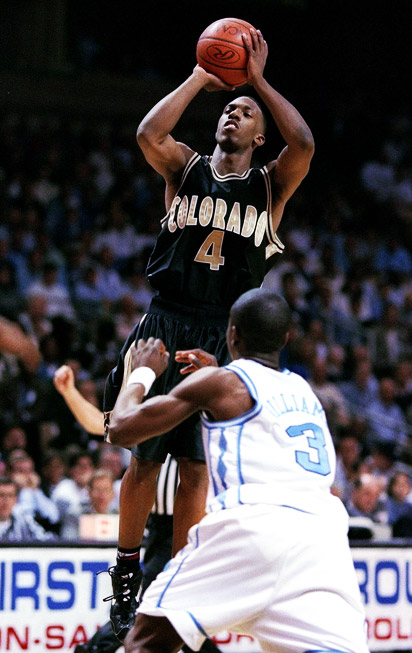
It's not a huge surprise, but the great Chauncey Billups made it official yesterday when he announced his retirement from the NBA.  An unrestricted free agent since the Pistons declined to pick up his $2.5 million option in July, Billups had quietly mulled continuing his career with other teams, including the reinvigorated Cleveland Cavaliers, but decided that 'it's just time.'

The 17-year NBA veteran and Colorado basketball immortal leaves the game having accomplished what few can claim.  A five-time All-Star and 2004 NBA Finals MVP, he was legitimately one of the best players of his era, a smooth point guard known across the country for his clutch shooting and measured control of his team.  He won numerous honors, both collective and personal, while being a model citizen and ambassador of the game.  There were few like him.

After successful stints with seven different teams, it's easy to say Billups had national reach, but it's hard for me to think of him as anything other than Mr Colorado.  I'm not just talking about CU, he defined the pinnacle of the game from the high school ranks on up through the professional in the Centennial State. You'd be hard pressed to find of another athlete from a major sport who can claim to be a state's singular icon in the way Chauncey stood for hoops in Colorado. For basketball fans on the Front Range, his exploits were a source of continuing pride. 'Absolutely, we belong - just look at the King of Park Hill!'

But the wear of all those miles as a leading man had begun to show, as the star had only seen action in 61 games over the past three seasons.  With nearly everything possible accomplished in the game he loves, I imagine he retires with a clear mind and few regrets.

I'm sorry to say, but my CU fandom is purely ex post facto Chauncy's tenure in Black and Gold.  I have no direct memory of the Big Shot era in Boulder, no personal connection to the heroics that sent Bobby Knight on a cold, rainy walk home.  To me, Chauncey was always a professional athlete.  But even from my more neophyte view, it would be impossible to discuss the history of basketball at the University of Colorado without devoting volumes to #4.  Accordingly, there is simply no amount of gratitude that I can express that would live up to his contributions to the game in Boulder.  The best I can say is 'thank you Chauncey,' and hope he gets the successfully peaceful retirement that he has earned.

... also, a big damn statue outside of the CEC.

Saturday, February 15, 2014

2013-14 USC Basketball Preview #2: Mal-Ski's revenge

And now, for something completely different...

One month after playing through an error-prone home loss to the UCLA Bruins, CU decided to come out with a different tack in Westwood.  They went against convention, playing run-and-gun basketball, trading shot-for-shot with the effusive home team.  At least for 30 minutes it worked, and it was glorious.  The Buffs were playing beautiful, offensive basketball, and held a lead over the heavily favored Bruins on the road. Unfortunately, as is often the case when you try to out-shoot a shooter, Colorado tired out, and the Bruins just kept right on making shot after shot.  It was only a matter of time, and CU succumbed down the stretch, falling under the tide of a 56-point second half.  The 92-74 final was not indicative of the run of play, but that matters little.  A loss is a loss.

Overall, UCLA shot 57% for the game, and scored 1.3 points per possession. Even without another team guarding them, Colorado is going to be hard pressed to maintain that kind of pace. That doesn't mean they didn't try.  Behind a transformative performance from Askia Booker (who finished with 16 points and 12 assists), CU scored 40 first half points on only 16 shots.  It was probably the best the offense has looked all season. We'll always have that first half Paris.
Ski had a beautiful game in defeat.
The second frame was less-positive.  With 13 minutes to play, Colorado clung to a 53-52 lead.  UCLA proceeded to make seven of their next eight shots, including three of Bryce Alford's four made three-pointers, to take a 10-point lead that all but ended the game with 10 minutes to play.  It didn't help that, over this same stretch, Colorado began to panic and try to make up the gap with hasty three-pointers.  For the second half, CU would finish 3-15 from beyond the arc, forsaking the interior completely, and becoming very easy to guard.

With their three best defenders on the bench due to injuries, guarding the Bruins was always going to be an issue.  Coach Boyle admitted as much in the opening minutes, when he had the team come out in a loose and ineffective 2-3 zone.  Because they don't know how to play a zone properly, that idea had to go, and CU played man-to-man the rest of the way.  But that only accentuated the matchup issue, and players like Kyle Anderson and Travis Wear took advantage of playing against smaller defenders.  Anderson was especially magnificent, going for 22/11/7 without Wes Gordon to guard him.
Coach Boyle could only watch as Kyle Anderson gashed his defense.
I will cop to becoming seduced by the offensive fireworks.  Twice I tweeted about how much fun I was having watching the game, which, while true, covered over my knowledge that the pace and style of play was not sustainable for 40 minutes.  It may have been fun and entertaining, but that kind of basketball is not winning basketball for Colorado against the better teams in this league.  They have to play defense, they have to stick to their principles.  The simple fact is that CU isn't going to win many games played in the mid-160s, especially on the road.

The result against UCLA, on its own, is not devastating, it's not even really all that painful.  A winless trip to SoCal, however, would probably put the Tournament out of reach.  CU has a solid opportunity to salvage the necessary split tomorrow night against the Trojans.  The game is not only winnable, it's probably the only date the rest of the way that the Buffs will be favored in.  They need to take advantage.

--

Tip-off from the Galen Center in downtown Los Angeles is set for 6pm tomorrow evening.  The run of coverage on the ESPN family of networks continues, as the game can be seen on ESPNU.  Mark Johnson and the radio call will on 850 KOA, per usual.

For reference, my preview from the first game can be found here.

Click below for the preview...


Monday, January 13, 2014

Monday Grab Bag: Black Sunday

There are moments in sports where the outcome of a game becomes meaningless.  Such was the case Sunday when Spencer Dinwidde fell to the floor clutching his knee.  Time stopped, the game fell away, and a haze of uncertainty fell over BuffNation.
It's just not right.  From: USA Today
The obvious is that the whole situation did not look good.  The injury occurred in a non-contact situation, where Spencer's knee seemed to give out from under him as his shoe slipped on the slick floor at the Hec Ed Pavilion in Seattle.  Spencer wasn't the only one to lose his footing, and I can't help but wonder if the coaching staff should've made an issue of it.  Regardless, dreams, both individual and organizational, came to a screeching halt.

The fear is that Dinwiddie is done for the year. It's a knife to the gut, a painful reminder that success is fleeting.  In the coming days I'll be able to consider what this means going forward, but, for now, all of my thoughts and prayers go out the the 'Mayor of Buffaloes.'  Get well soon, Spencer.

--

Today in the bag, I'll pick up the pieces from Seattle, check in with the spiraling women's team, and touch on the NFL playoffs.

Click below for the bag...

Thursday, June 27, 2013

2013 NBA Draft Preview: Will Andre Roberson get selected?

There's a lot of uncertainty headed into this evening's NBA Draft.  With no unquestioned superstars headlining the class, the first round could be both chaos and entertaining television.

Closer to home, the uncertainty takes on a different form: what is the fate of CU's former defensive dynamo, Andre Roberson? Ever since his quiet announcement two months ago that he would forgo his final year of collegiate eligibility, BuffNation has fretted over this risky choice, and whether it was a 'good decision' or not.  Tonight's result will go a long way towards providing an answer.

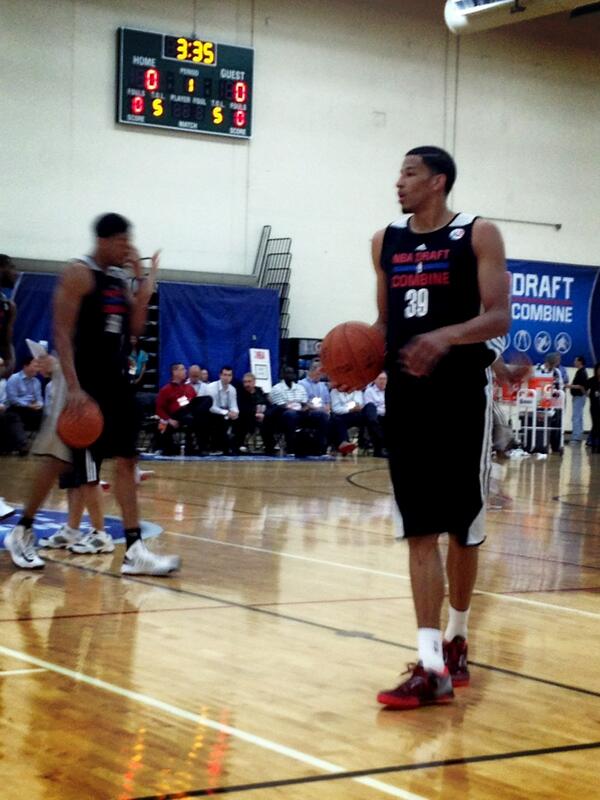
At first, the process didn't look kind to the reigning Pac-12 Defensive Player of the Year.  He came in undersized at the Draft Combine, and even 'Dre himself admits that his on-court performance those two days could've been better.  Combined with lingering questions about his offensive skillset, this lead to many experts leaving him off of their draft boards, even while teams like Orlando and Detroit were taking a closer look.
The Combine wasn't necessarily kind to Roberson.  From: @RealMatSmith
The consensus has shifted in recent weeks, however.  ESPN draft analyst Chad Ford, for one, was adamant this week that 'Dre will get drafted...


... and statistical analysis was released that projects Roberson to have the 3rd best Wins Above Replacement Player of any draft eligible player over the next five years.  'Dre, now seen as one of the best 'steals' available in an otherwise weak draft, was shooting up many mock boards, including Ford's, who has him going 41st overall to Memphis.

The key behind that shift seems to be a focus on the relatability of his skillset into the professional ranks. History has shown that defense and rebounding numbers put up in college are far more predictive of future professional success, and the more statistically inclined NBA GMs will react to what they have on paper. 
Rebounding was always going to be 'Dre's key to unlocking the NBA.
Still, some remain convinced that the most dynamic defensive force in the West will slip through the cracks, and into free agency.  Specifically, both NBADraft.net and DraftExpress have left him off their final mocks.  Doubt lingers.

In spite of that, I'm of a mind to be positive about this evening.  The recent trend is up, and I get the feeling that some GM will try to prove himself smarter than his competitors by reaching for a toolsy, athletic project like Roberson.

Despite Ford giving Roberson a surprise final grade of 'late first round pick', I think any hope of a 1st round pick is out of the question.  However, the statistical analysis of people like ESPN's Kevin Pelton has convinced me that 'Dre will get selected somewhere in the first 20 picks of the second round.  Specifically, I look at a team like Portland, who has back-to-back picks at #39 and #40, and see the potential for a chance taken on a 'glue-guy' project like 'Dre.

That kind of a result may not be as good as the Robersons may have dreamed, or BuffNation feared, but I think it's a happy medium.  Any drafted status is nothing to sneeze at, and a good agent should be able to turn a pick in the first half of the second round into some guaranteed money.

Regardless, this evening is the easy part. Starting tomorrow morning, it'll be up to 'Dre to see his NBA dream to fruition.

--

Of course, 'Dre isn't the only one hoping to hear his name called this evening.  Here is a list of some familiar names for BuffNation to listen for:

 - Ben McLemore - 6-5, SG - Kansas -

I really like McLemore.  He's an elite playmaker, and has the numbers to back it up.  He should easily go in the top-5.

- Shabazz Muhammad - 6-6, SF - UCLA -

Conversely, I've never been high on Muhammad.  Sure, he can score, but his attitude in college stunk, and he would rather lick the floor than play defense.  I just don't think he made UCLA better than they would've been without him.  He'll slip out of the lottery, but still find a nice paycheck.

- Allen Crabbe - 6-6, SG - Cal -

A great scorer with solid rebounding numbers as a 2-guard, Crabbe has always reminded me of Alec Burks.  Hopefully, whoever drafts him won't relegate him to the bench like the Jazz have with the former CU standout.

- Isaiah Canaan - 6-0, PG - Murray St. -

Canaan came back for his senior season, but I don't think it helped his draft stock any.  Still, he can shoot the lights out, and teams love to see points put up on the board.  Should be a late first rounder.

- Jeff Withey - 7-0, C - Kansas -

Another player who excels at defense and rebounding, Withey's selling point won't be as an offensive piece.

- Pierre Jackson - 6-0, PG - Baylor -

An undersized, yet skilled guard, I think Jackson will be a nice pickup for a team looking for some depth at the point. Also: Fuck Baylor.

- Grant Jerrett - 6-10, PF - Arizona -

Jerrett took a big risk by turning pro after single collegiate season spent mostly riding the pine.  He's been rated near Roberson on many 'big boards.'

- Colton Iverson - 7-0, C - CSU -

The bulky Ram makes the list for his size and motor, but I don't think any GMs will overlook his low-level athleticism and age to spend a pick on him. Solid prospects as a free agent, though.

- Arsalan Kazemi - 6-8, PF - Oregon -

The metrics wonder.  I'm very interested to see if the under-rated Iranian gets a late call this evening.

- Solomon Hill - 6-7, SF - Arizona -

Hill has all the talent in the world, but often gets lost on the court for long stretches.  I don't think he will get drafted.

Monday, November 5, 2012

Monday Grab Bag: Game Week!

WOOO!  GAMEWEEK!  Finally, after seven months of waiting, I'm about to get to see some actual basketball played.  I couldn't be more excited.

To further whet your appetite for the start of the season, I recommend heading over to AllBuffs where resident hoops guru Goose has been laying down some serious knowledge.  Through six editions, he's been taking a thorough look at the schedule, breaking down each opponent, and even inviting the thoughts of Pac-12 savant Adam Butler (better known as @pachoopsab).  It's well worth your time, and I may be making an appearance as the series reaches its conclusion later this week...

As for the here and now, in the bag today I'm talking more hoops, brushing off the football program, and briefly looking at the highlights from a packed football weekend.

Click below for the bag...

Wednesday, November 9, 2011

UPDATED: Basketball Signing Day

Updated: All five have signed their LOI's.  Welcome aboard guys!

Unlike football, which waits until the dead of February to ink the recruits, basketball allows teams to get the heavy lifting out of the way before the season even starts.  The first of two signing periods, the early signing period allows recruits to commit to their program of choice and play their senior seasons without the hassle of recruiting weighing on their performance.  They also lock in the guarantee of a scholarship, essentially insuring themselves against injury or other terrible happenstance.

Today marks the start of a full week of early signing availability, and all of the Buffs five commitments are expected to sign during the week, if not today.  With little opportunity to improve the team with the 2013 class (seeing as how the team has only one junior: walk-on transfer Sabatino Chen) the 2012 class is essential to the future growth of the program.

All told, three native Coloradans and two out-of-staters look to make CU very competitive in the future.  This is a solid class, easily one of the best, if not the best, in school history, with two of the commitments considered top-100 players nationally.  It's focused on high-motor players who showcase plenty of athleticism - perfect fits in the up-tempo style of ball that Coach Boyle likes the Buffs to play on both ends of the court.

Many consider this class to be one of the top-20 in the nation, and one of the better landed in the Pac-12 this fall.  While it would have been nice if Coach Boyle and his staff were able to land all of the top-flight recruits interested in coming to Boulder, I'm still more than satisfied with how the class turned out.

In this post I'll be recapping the class; touching on each player's recruiting profile and how I see them impacting the Buffs over the coming years.

Click below for the recap...


Wednesday, May 4, 2011

Quick Post: Bring Baseball Back to CU!

Let me paint the picture: It's a beautiful May afternoon, sunny and in the low 70s.  You take the afternoon off from work, meander into Boulder, and grab some seats just beyond the 3rd base bag.  The stadium perfectly frames the flatirons in right-center field, and, with a beer in your hand (oh, there will be beer sales), baseball begins to unfold in front of you.  All is right with the world.  

Baseball needs to come back to Boulder.

Now that CU Athletics will be flush with cash in the forthcoming years, I think it's time to seriously start talking about bringing varsity baseball (and softball) back to CU.  Pac-12 commish, and all around badass, Larry Scott stated today that the 3 billion in TV dollars will allow for adding back of sports that have been cut.  If the Pac-12 wants to have an emphasis on it's total athletic package, not just on football and men's basketball, then I'm sure Mr. Scott will look to have the member institutions actually follow through on this concept.

There's been half-hearted efforts pushed in years past, but now's the time to seriously push for varsity baseball.  I'm not looking for it to happen next year, and I realize fund-raising for a new stadium may take years (can we use capital constructions funds?), but if Cal can find enough offsets to equal the $1 million/season operating budget (and save their team from the financial axe), then the creative team at Dal Ward should be able to as well.  Let's make it happen!

Thursday, April 8, 2010

Quick-Post: The continuing saga of liquor laws in Colorado.

Consider this a non-Friday Beer Post. I ran across something interesting in this mornings Denver Post. The grocery store lobby in this state continues to try and get full-service liquor license rights for it's supermarket members. I don't want to get too political with this site, but it's about beer (and our ability to purchase it), so damn it, I'm gonna talk about it.

Over the past year, there have been varying pushes by convenience stores and supermarkets to crack into the liquor selling industry. In Colorado, the only stores that can regularly sell full strength liquor or beer are full-time liquor stores. One of the first things I noticed when moving to Boulder (admittedly a college town) was the fact that there was at least one liquor store for every commercially zoned block. Many of these stores would be muscled out by mega-marts undercutting their prices on staple beer and liquors. While large liquor retailers, like LiquorMart or TotalBeverage will get along just fine, the smaller stores will slowly cease to exist. What this would bring to the state is 3-fold:
  1. Less liquor license revenue. With the right to sell full-strength alcohol resting only in the hands of small-ish liquor stores, the state gets more revenue from the sale of liquor licenses than it would if the mega-marts had the same ability. There are some 1600 licenses in the state currently, and that number would decrease rapidly if mom-an-pop stores were bought out. Business license and tax revenues goes along with this concept.
  2. Fewer jobs. Along the same line, with the current system, the large amount of small, dedicated liquor stores means more jobs. If the supermarkets are allowed to sell liquor, many of those extra retail jobs would disappear.
  3. Less variety. Supermarkets have their own national distributors, and it is often hard for micro and craft breweries to get onto supermarket shelves. In Colorado, because of the high number of independent liquor stores, there is a higher level of competition in the market. I know I choose what liquor store to go to based not on location or convenience, but by selection and price, and I have plenty of option to choose from.
I see no benefit to Colorado in giving the mega-marts the ability to sell hard liquor. Much of the extra income generated would leave the state, as those corporations are national, and not local. Add to that the loss of license and tax revenue, jobs, and variety, and it just makes no sense to change the current law. The proposal in the linked article is doubly worrisome. Smaller stores would just be bullied into selling out to the mega-marts. If you don't think there'd be intimidation involved, then you're just fooling yourself. In addition, closing two stores every-time a mega-mart starts selling liquor would just accelerate the loss of small businesses and jobs. It's crap legislation, and needs to die in committee.